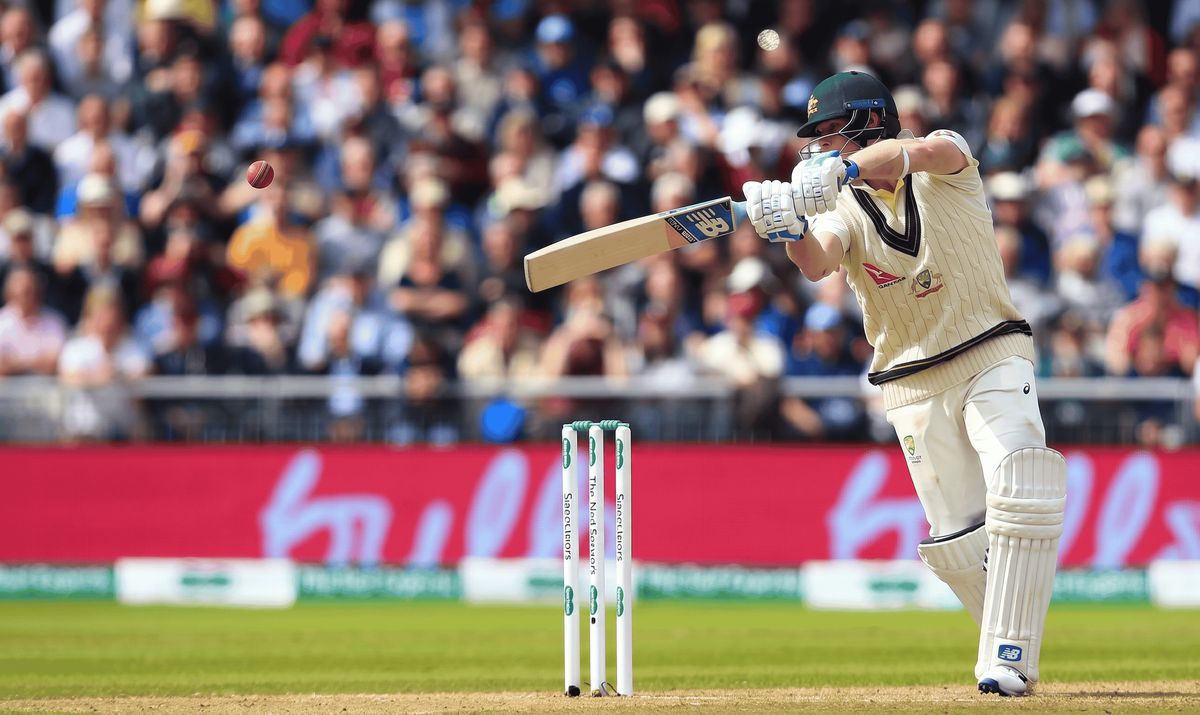
Show a coach Steve Smith's batting stance for the first time, without telling them who it is, and most of them will instinctively want to fix it.
The stance is open. The backlift goes towards gully, not straight back. He moves his weight onto the back foot before the ball is bowled, sometimes dramatically so, in what looks like a pre-movement shuffle that no coaching manual recommends. His head position at the crease shifts constantly. He plays the ball late. Very late. Sometimes uncomfortably late.
By the textbook, Steve Smith bats wrong.
By the scoreboard, Steve Smith has over 9,000 Test runs at an average above 58, one of the highest in the history of the game. In the 2019 Ashes series, returning from a 12-month ball-tampering ban, he scored 774 runs in 7 innings at an average of 110.57. Against arguably the best bowling attack in the world. On their home ground.
So either the textbook is wrong, or Steve Smith is doing something the textbook can't explain. The answer, as usual, is somewhere more interesting than either.
The Stance: Deliberately Uncomfortable
Smith sets up with an open stance: his front foot angled towards mid-on rather than pointing down the pitch. His body is slightly turned to face the bowler more front-on than a classical batter would allow.
This immediately creates a problem that he then spends the rest of his technique solving.
An open stance naturally pulls the batter towards the leg side. It opens up the on side but closes off the off side. For most batters, this means they struggle to drive through the covers or play the cut shot effectively. The geometry just doesn't work.
Smith compensates with his head position. His head stays remarkably still and angled slightly towards the off side, counterbalancing the open stance. This keeps his eyes level and his weight balanced, neutralising what the open stance takes away.
The result is a stance that looks wrong but functions correctly. Every unorthodox element has a compensating element that makes the whole thing work.
The Backlift: Towards Gully, Then Back
Classical batting technique prescribes a backlift that goes straight back towards the stumps (or slightly towards fine leg), keeping the bat in the V between mid-on and mid-off and ensuring it comes down straight.
Smith's backlift goes towards gully. Significantly towards gully. It loops up and away from his body on the off side before coming down to meet the ball.
Why does this work?
Two reasons. First, the looping backlift gives Smith a longer arc: more time, more momentum, more power when he does choose to hit. Second, and more importantly, Smith generates his power not from the backlift but from his wrists and forearms at the point of contact. His hands are extraordinarily strong and quick through the ball. The backlift is almost irrelevant to his power generation. It's his hands that do the work.
The danger of a gully backlift is that the bat can come down at an angle, creating an inside edge onto the stumps or pads. Smith mitigates this with the single most important technical element of his game: his head position at the point of contact.
The Head: The Secret to Everything
Watch any Steve Smith dismissal (there are mercifully few in Tests) and you will almost always find the same thing: his head has moved away from the line of the ball.
Watch any Steve Smith boundary (there are rather more) and you will find the opposite: his head is perfectly still, perfectly level, directly over the ball at the point of contact.
This is the central technical truth of Steve Smith's batting: his head controls everything else.
When his head is in position, the unorthodox backlift, the open stance, the pre-movement, all of it aligns. The bat comes through straight. The weight is in the right place. The ball goes exactly where he wants it.
When his head falls over, usually when he's trying to hit across the line, the whole system collapses. England discovered this in 2013-14. Stuart Broad discovered it less reliably in 2019.
The irony is that Smith's head discipline is actually more consistent than most orthodox batters, precisely because he has to work harder to maintain it. His technique has no margin for error on the head position, so he's drilled it to near perfection.
The Pre-Movement: Manufacturing Time
This is the element that confuses analysts the most.
Before the ball is bowled, Smith moves. Sometimes dramatically. He shuffles back and across his crease, transferring his weight to the back foot before he could possibly know whether the delivery is full or short, swing or seam, on or off stump.
Conventional wisdom says this is dangerous: you're committing your weight before you have information. A good length ball on off stump to a batter who's already moved back becomes a very difficult shot. You're either playing from the crease with no momentum forward, or reaching for the ball with your weight going the wrong way.
Smith uses the pre-movement to do something different: he's not committing to a shot, he's resetting his base.
By moving back and across early, he creates more space between himself and the stumps, giving his hands more room to work and his eyes more time to read the ball. He's essentially making the pitch longer for himself. A good length ball to Smith is a slightly different ball than a good length ball to a batter standing tall in his crease.
The pre-movement also disrupts the bowler's mental picture. Every bowler has a map of where a batter stands and where the stumps are. Smith is constantly shifting that map mid-delivery, making it harder to hit a consistent line. Bowlers who rely on hitting the top of off stump with a good length ball find that Smith has simply moved the target.
Playing Late: Seeing the Ball Longer
Smith plays the ball extraordinarily late, later than almost any elite batter in modern cricket.
Most batters commit to their shot when the ball is roughly halfway down the pitch. Smith waits. He keeps his options open longer, reads more information (seam movement, late swing, pace off the pitch) before committing. The shot still gets made in time, but the decision is made with more data.
This is not a natural skill. It's a trained one, the product of thousands of hours of practice specifically designed to delay the point of commitment. Smith has spoken about using a specific training method: facing deliveries with the instruction to wait as long as possible before playing, even if it means getting hit. The discomfort of the drill trains the patience needed in a match.
The late play is also connected to his extraordinary conversion rate. Smith converts 50s into 100s at one of the highest rates in Test history. Batters who play early and commit hard get out when the ball does something unexpected late. Smith, still reading the ball when others have already swung, simply adjusts.
The Mental Architecture Underneath
Technique doesn't exist in isolation. What makes Smith's unorthodox method work isn't just the physical mechanics. It's the mental system that holds it together.
Smith is a process batter in a way that few modern players are. He's spoken extensively about batting in terms of processes rather than outcomes: not thinking about runs or averages or pressure, but about this ball, this shot, this moment. The pre-movement, the late play, the head position: these aren't reactive. They're a deliberate system he runs on every single delivery, regardless of the score or the situation.
When he's dismissed, he almost never looks surprised. He looks like someone who ran the process and got an outlier result. He accepts it, because the process was right even if the outcome wasn't.
This is unusually mature thinking for a batter: the ability to separate process quality from outcome quality. Most batters, when they get out to a good ball after doing everything right, still feel like they failed. Smith doesn't. He's already thinking about the next innings.
What Bowlers Have Found and What Still Doesn't Work
England's strategy in 2013-14 was to bowl full, straight, and swing the ball late into Smith's pads. The theory: his open stance leaves him vulnerable to the inswinger that straightens, particularly if it's full enough that he can't get behind it.
It worked for a while. Smith averaged 32 in that series, good by most standards, not by his.
By 2019, he'd solved it. The same bowlers, the same plans, and Smith averaged 110. What changed? His weight distribution against the full inswinger, and his head position on the ball that comes back in late. He identified the weakness, fixed it, and the plan stopped working.
The honest truth about bowling to Smith is that there is no reliable plan. There are plans that create chances. But against a batter with his level of technical self-awareness and his capacity to adapt mid-series, every plan has a shelf life.
The best approach, which even this analysis ultimately confirms, is to bowl to the top of off stump, vary the pace, and hope for an error. It's not satisfying. But it's the reality of facing one of the best Test batters of his generation.
Steve Smith is the best argument against coaching orthodoxy that cricket has produced in a generation. Not because technique doesn't matter (it does, deeply) but because technique is a means to an end, not an end in itself. The end is hitting the ball effectively and not getting out. Smith achieves that end through a method that looks wrong at every step and works at the highest level.
The lesson isn't to bat like Smith. Most people can't: the compensating elements of his technique require a level of physical coordination and mental discipline that took him a decade to develop. The lesson is that understanding why something works matters more than copying what it looks like.
Cricket has always rewarded the unorthodox who understand themselves well enough to make the unorthodox reliable.
Think you can read a game like Smith reads a delivery? Test your cricket IQ at the Cricket Codex, every term, tactic, and technique explained properly.
Think you know your cricket legends? Guess the Legend is a new cricketer every day — six clues, six guesses.