There are cricketers who dominate through technical perfection. There are others who win through relentless preparation. And then there is Sir Vivian Richards: a batsman who seemed to operate on a different psychological frequency from everyone else who shared a pitch with him.
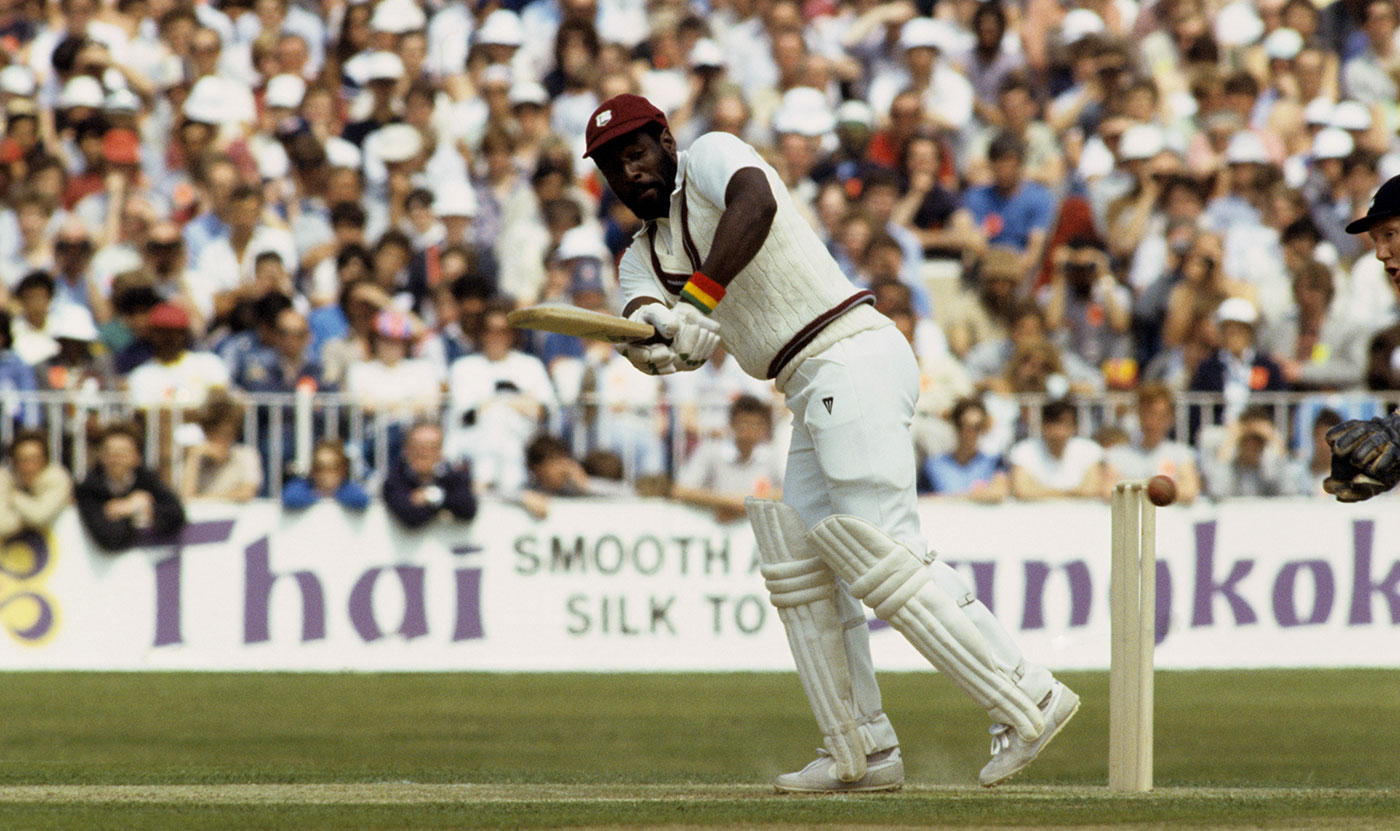
He did not wear a helmet. He chewed gum. He walked to the crease with a gait that suggested the match had already been decided in his favour. In an era when pace bowling was at its most fearsome, Richards chose to face it without a helmet, as a statement rather than an oversight.
The Era He Walked Into
The 1970s and 1980s were not kind to batters. Protective gear was limited. Pitches were often unpredictable. Fast bowlers operated with minimal restriction: short-pitched deliveries were a routine tactic, not a novelty. Roberts, Holding, Garner, Croft, Marshall. The West Indian pace battery of that era remains the most intimidating bowling attack the game has ever assembled.
Richards played alongside them, led them, and then batted against attacks of comparable ferocity from other nations. His response to hostile bowling was never to absorb it or work around it. It was to attack it with enough authority that bowlers reconsidered their plans before the next delivery.
He was, in the plainest terms, not afraid. And that absence of fear changed every calculation a bowler had to make.
The Technique Behind the Dominance
What is often missed in discussions of Viv Richards is that the fearlessness was backed by exceptional technical quality. His pull shot was not a desperate heave. It was balanced, timed, and executed from a position of complete control. His judgment of length was rapid. He picked up the ball early and committed to his shot without hesitation.
That combination (early pickup, clean footwork, and absolute commitment) is what separated him from batters who simply tried to take the attack on. Richards did not swing hard and hope. He read the delivery, decided in fractions of a second, and executed with a precision that made it look effortless.
Watch footage of his innings today and the footwork is striking. He was not standing and hoping to time the ball through pure hand-eye coordination. He was moving correctly, putting himself in position, and then allowing the timing to follow. The aggression was built on technique, not on recklessness.
Records That Still Hold Weight
In 121 Tests, Viv Richards scored 8,540 runs at an average of 50.23, with 24 centuries. In ODIs, he accumulated 6,721 runs with 11 hundreds. At the time of his retirement, he held the record for the fastest ODI century (56 balls against England in 1986) at Antigua, a record that stood for nearly three decades.
His 189 not out against England at Old Trafford in 1984 remains one of the greatest ODI innings ever played. He reached his century off 108 balls but then accelerated dramatically in the final stages. Long before T20 cricket normalised aggressive white-ball batting, Richards was playing that way in 50-over games. He was ahead of his time in the most literal sense.
The Captain Who Demanded More
When Richards took over the West Indies captaincy, he inherited a side that was already dominant. What he added was culture and expectation. Pride was non-negotiable. Standards were set by example. He did not give elaborate tactical instructions. He walked to the crease in a tight game and made the game irrelevant by dominating it.
Under his captaincy, West Indies were the undisputed best team in world cricket across multiple formats. The combination of his batting and his leadership created an environment where opponents arrived expecting to lose. That psychological weight was worth runs before a ball was bowled.
He was also a demanding captain in the best sense: he expected full commitment from his players because he gave nothing less himself. Players who fell short of the standard he set found themselves on the receiving end of his directness. Players who met it found themselves part of something historic.
His Influence on the Modern Game
Virtually every aggressive batsman of the modern era, from AB de Villiers to Rohit Sharma to Ben Stokes, has spoken about Richards as a foundational influence. The idea that a batter could dictate the terms of engagement, could treat a Test match as a platform for aggression rather than survival, owes much of its cultural legitimacy to what Richards did across the 1970s and 1980s.
He showed that batting could be an act of will, not just skill. That a fielding side's plan could be made irrelevant not by luck but by someone who simply refused to play within the constraints that plan assumed.
Grassroots cricket across the Caribbean and around the world still measures attacking batters by the Richards standard: the willingness to take ownership of an innings, to assert rather than react. For teams looking to build that kind of competitive environment through organised fixtures and tournaments, Crickonnect's tournament management tools give cricket communities the structure to run competitive cricket where performances like these have a stage.
Also read: Adam Gilchrist: The Left-Handed Lightning Who Changed the Game, another player who redefined what was possible in their role.
Think you know your cricket legends? Guess the Legend is a new cricketer every day — six clues, six guesses.