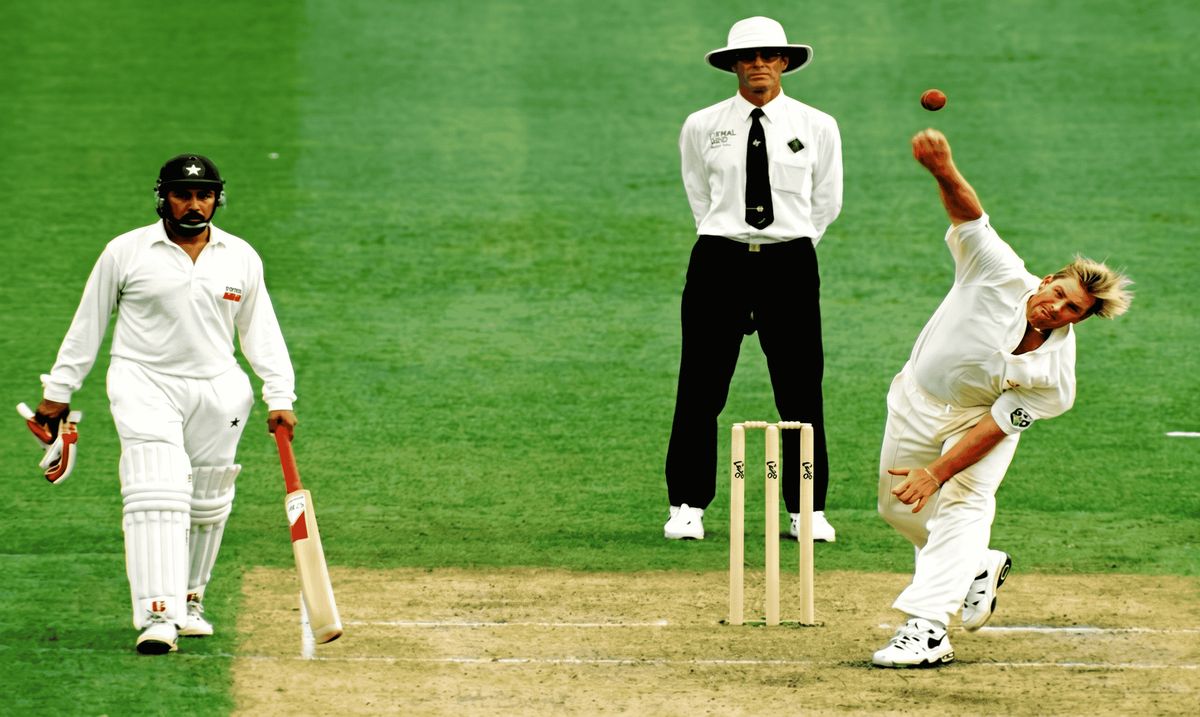
The batter reads the leg-spinner's hand. They see the wrist position. They plant their foot and prepare to play towards mid-wicket. The ball pitches and turns the other way. They're bowled around their legs. The spinner is already walking back to their mark, job done.
That's the googly. And for over 100 years, it has been the most deceptive delivery in spin bowling.
What Exactly is a Googly?
A googly is a delivery bowled by a leg-spin bowler that turns the opposite way to a standard leg-break. Where a normal leg-break turns from leg to off for a right-handed batter, a googly turns from off to leg, into the right-handed batter, like an off-spin delivery.
The deception is everything. The bowler's action looks identical to a leg-break. The wrist position is slightly different: the ball is delivered out of the back of the hand. But to a batter watching from 22 yards away, at pace, it's almost impossible to spot. The batter plans for the ball to turn one way. It goes the other. They're undone by their own reading of the game.
How is a Googly Bowled?
In a standard leg-break, the wrist rotates so the top of the hand faces the batter at the point of release. The seam spins from right to left, creating conventional leg-spin turn.
For a googly, the wrist rotates further, fully over, so the back of the hand faces the batter at release. The ball is delivered from the back of the hand, and the seam now spins in the opposite direction.
It's physically demanding and takes years to master. The wrist has to go through a much larger rotation in the same bowling action without telegraphing the change. The best googly bowlers could bowl it so subtly that even the wicketkeeper sometimes couldn't pick it.
Who Invented the Googly?
The googly was invented by B.J.T. Bosanquet, an English cricketer, around 1900. He reportedly discovered it while playing a table game called Twisti-Twosti where he experimented with making a ball turn the wrong way off a table. He then translated it to cricket.
It caused immediate confusion. Batters had never seen a leg-spinner's ball turn into them before. The delivery became known in Australia as the Bosie after its inventor, though googly became the universal term.
Within a decade, every serious leg-spinner was trying to learn it. A century later, it's still the delivery that batters fear most from wrist spinners.
The Googly vs. The Doosra
Both are wrong-un deliveries: balls that turn the unexpected way. But they come from different types of spinners.
- The googly is bowled by a leg-spin bowler. Their stock ball turns from leg to off; the googly turns the other way.
- The doosra is bowled by an off-spin bowler. Their stock ball turns from off to leg; the doosra turns the other way.
Both have the same principle (the unexpected reversal of spin) but the mechanics are completely different.
How Do Batters Try to Pick the Googly?
Experienced batters watch for wrist position, seam angle, and trajectory. In a leg-break, the wrist cocks towards the batter. In a googly, it rotates further over. But elite bowlers disguise this: the difference might be just a few degrees.
A googly often dips slightly differently in the air than a leg-break, due to the different spin axis. Experienced batters claim they can feel this, though against elite wrist spin most still get it wrong.
The safest approach is to play late, avoid committing too early, and adjust after the ball has turned. The batters who get into trouble are the ones who commit early based on their read.
Why the Googly Matters for T20 Cricket
In T20s, batters are pre-meditated constantly. They're looking to swing before the ball arrives. Against a leg-spinner, they'll identify the leg-break and plan to hit with the spin through the on side.
The googly exploits that pre-meditation completely. The batter has already committed to hitting one way, and the ball is going the other. There's no time to adjust. It either goes onto the stumps or, if they do connect, it goes straight to a fielder in the wrong position.
This is why good leg-spinners are so valuable in T20 cricket despite getting hit often: one googly at the right moment is worth four expensive overs.
The googly is over 120 years old. It's been studied, analysed, bowled by the greatest spinners in history, and faced by the greatest batters in history. And it still works. That's how good the deception is.
Explore more cricket terms, deliveries and tactics at the Cricket Codex, your complete cricket glossary.