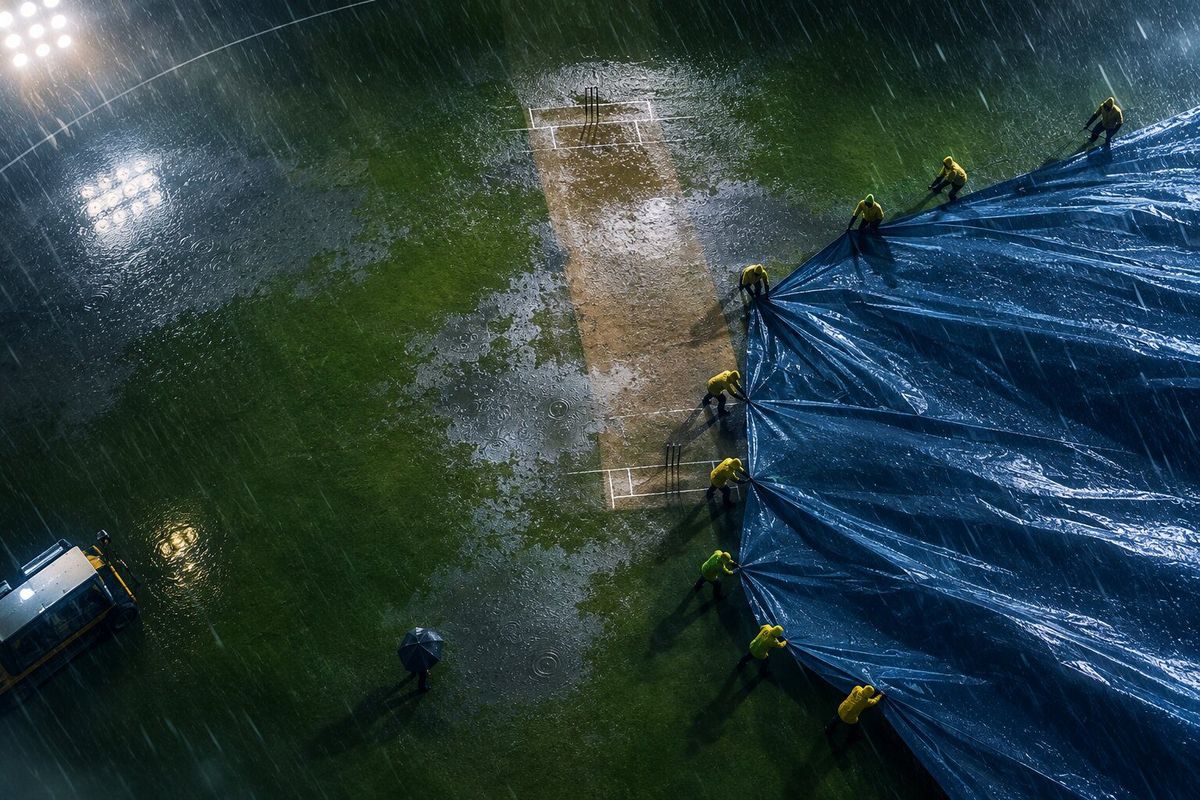
Rain starts falling. Players jog off. The covers come on. And when play resumes (if it resumes), the chasing team doesn't need the original target anymore. They need some new number, like 187 off 32 overs, that nobody in the stadium calculated themselves. Commentators say "DLS par score" like everyone already understands it. Most people don't. Here's what's actually happening.
The Problem DLS Solves
Before any rain method existed, rain-affected matches were decided by Average Run Rate: simply scale the target down by the percentage of overs lost. Sounds fair. It isn't.
Say Team A scores 300 in 50 overs, mostly by batting cautiously early and exploding in the last 10. Team B's innings gets cut to 25 overs by rain. Average Run Rate says: Team A scored 6 runs an over, so Team B needs 6 x 25 = 150. But Team A's first 25 overs only produced 110 runs. They scored the rest in the death overs Team B never gets to bat. Team B is chasing a target built on overs that don't reflect how run-scoring actually happens across an innings. This is exactly what got India eliminated from the 1992 World Cup semi-final in one of cricket's most notorious injustices: needing 22 off 1 ball after a rain revision. That result is the reason DLS exists today.
The Core Idea: Resources, Not Just Overs
Duckworth-Lewis-Stern doesn't think about overs remaining. It thinks about resources remaining: a combined measure of both overs left AND wickets in hand. A team with 25 overs left and 9 wickets standing has vastly more scoring resources than a team with 25 overs left and 2 wickets standing.
Statisticians Frank Duckworth and Tony Lewis built a resource table (later refined by Steven Stern, hence the added "S") using decades of historical match data. It answers one question for any combination of overs-and-wickets: what percentage of a full innings' scoring potential is still available? Teams start a 50-over innings with 100% of their resources. Losing overs to rain, or losing wickets, both eat into that percentage, just at different rates depending on when they happen.
How the Target Actually Gets Calculated
The simplified logic looks like this:
1. Work out resources for both teams
Team A's resource percentage is based on the full innings they played. Team B's resource percentage is based on the reduced overs (and wickets, if they've already started batting when rain hits) they'll actually get.
2. Compare the two percentages
If Team B has fewer resources than Team A had, their target is scaled down proportionally. If a rain delay happens mid-innings while Team B is batting, and they actually have MORE resources left than Team A used at that stage, their target can, counterintuitively, go up.
3. Add the G-resource adjustment
For a par score (used when a match is abandoned mid-chase), the target also factors in a par run value for a full 50-over innings, ensuring results reflect a complete match's typical scoring pattern rather than just a straight percentage cut.
None of this happens on a scrap of paper anymore. Every major broadcaster runs DLS software live, updating the required target the moment overs are lost, which is why the new target can appear on screen within seconds of an interruption being confirmed.
Why the Target Sometimes Looks Unfair
The most common complaint: "Team B only needs 6 an over now, that seems too easy." But DLS isn't trying to replicate the original required run rate. It's trying to give both teams an equal SHARE of resources used. If Team A used their resources aggressively in the death overs, and Team B has fewer overs to replicate that same aggression, DLS accounts for the fact that batting out a shorter, sharper chase is a fundamentally different task than batting a full 50.
The system isn't perfect. It assumes teams bat in patterns similar to historical data, which doesn't always hold for a specific match. But it is dramatically fairer than raw run-rate scaling, and it's been stress-tested across thousands of international matches since 1997.
Where You'll See It in Action
DLS decides matches most visibly in ICC tournaments played in monsoon-prone regions: the Champions Trophy, T20 and ODI World Cups hosted in South Asia and England both see multiple DLS-affected results every edition. It's also why teams sometimes make bizarre-looking tactical calls when rain is forecast: batting first to "bank" a strong total before resources shrink, or a captain choosing to bowl first specifically because the forecast favours a shorter, DLS-adjusted chase. Rain isn't the only thing that can decide who progresses in a group stage, either. See how Net Run Rate settles ties when points finish level. Think you'd make the right call with rain closing in mid-innings? Field Marshal has a scenario built around exactly that.
Next time the covers come on and the required total flashes up on screen, you'll know it isn't a random number. It's a resource calculation built to make an unfinished match as fair as a finished one can be. Want to work one out yourself instead of waiting for the broadcast graphic? Try the DLS Calculator, built on the real published resource table.
Want more of cricket's rules broken down without the jargon? Head to The Rulebook for the laws, or Cricket Codex for the terminology.