The DLS method looks like magic on TV, but the calculation behind it is just percentages. This guide walks through three real situations using the published Duckworth-Lewis Standard Edition resource table, the same table behind our DLS Calculator. New to the idea? Start with What Is the DLS Method?
A note on accuracy: the exact table used in televised internationals is proprietary and refined by Steven Stern, so on-air numbers can differ slightly from these. The method and logic are the same.
The Formula in One Line
Par score = Team 1's total × (Team 2's resources ÷ Team 1's resources)
Resources are percentages. A full 50-over innings with all 10 wickets in hand is 100%. The target is the par score rounded, plus 1 run. To win, Team 2 must go past par.
Example 1: Team 2's Innings Is Shortened Before It Starts
Team 1 bats a full 50 overs and scores 280. Rain cuts Team 2's innings to 30 overs before they begin.
- Team 1 resources: 100%.
- Team 2 resources: 30 overs and 0 wickets lost = 75.1%.
- Par score: 280 × 0.751 = 210.3.
- Target: 210 + 1 = 211 off 30 overs.
Notice that the run rate has gone up: 280 off 50 is 5.6 an over, but 211 off 30 is about 7.0. That's expected: a shorter innings lets batters attack from the start, and DLS prices that in.
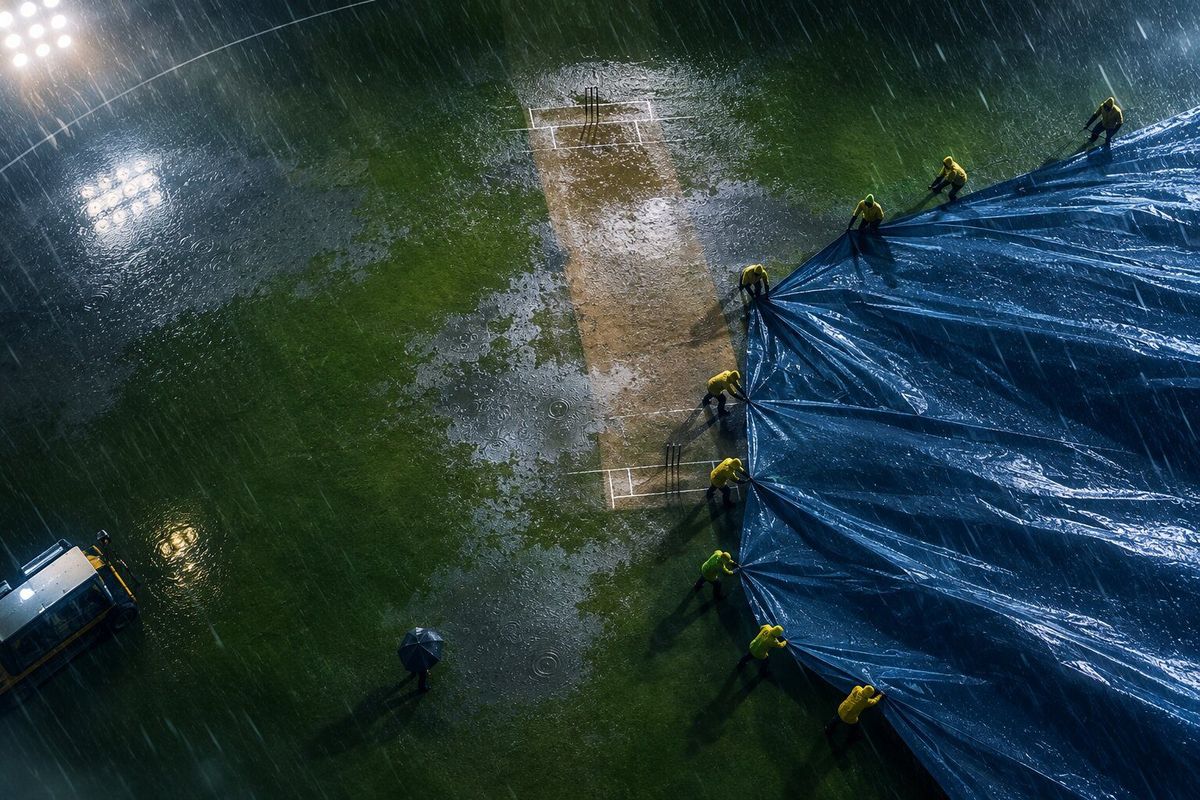
Example 2: Rain Ends Play Mid-Chase
Same match, Team 1 scored 280. Team 2 are 2 down after 20 overs when rain ends the game for good.
- Overs remaining: 30, wickets lost: 2. Resources still available to Team 2: 67.3%.
- Resources used: 100 − 67.3 = 32.7%.
- Par score: 280 × 0.327 = 91.6.
If Team 2 had scored 92 or more at the time, they win on DLS. At 91 or fewer, Team 1 wins. It's the wickets in hand that matter: with 8 wickets left, Team 2 still hold most of their resources, so the par score is low.
Example 3: Rain Interrupts and the Innings Is Cut
Team 1 scored 280 off 50. Team 2 are 2 down after 20 overs when rain stops play. When play resumes, the innings is revised to 35 overs in total, which leaves 15 more overs.
- Resources before the stoppage (30 overs left, 2 down): 67.3%.
- Resources after the stoppage (15 overs left, 2 down): 42.6%.
- Resources lost: 67.3 − 42.6 = 24.7%.
- Team 2's total resources: 100 − 24.7 = 75.3%.
- Par score: 280 × 0.753 = 210.8, so the target is 211 off 35 overs.
The key idea: resources lost during a stoppage are subtracted from Team 2's total, so a stoppage late in the innings, or with many wickets left, costs more than an early one.
Why Wickets Matter as Much as Overs
Look at the resource table and you'll see why a team 2 down with 30 overs left (67.3%) is far better placed than a team 5 down with 25 overs left (42.2%). DLS treats wickets as a currency you spend over the innings, which is why losing early wickets before a rain break can sink a chase.
Minimum Overs for a Result
DLS only applies if enough play happened. In international cricket, each side needs to face at least 20 overs in an ODI and 5 overs in a T20 for a result.
Run Your Own Numbers
Put your own scores into the DLS Calculator, or read how the rain rules changed over time in DLS vs Average Run Rate vs Most Productive Overs. More terms are in the Cricket Codex.